Morocco travel: 100 questions and answers
100 straight answers from our local team — planning, the Sahara, prices, culture and practical tips.
Planning your trip
How many days do I need in Morocco?
Plan at least 7 days for a first trip: enough for one imperial city, the Sahara and Marrakech. With 3 days you can do Marrakech and one night in the desert; 10 days covers the four imperial cities, Chefchaouen and the Sahara at a relaxed pace; two weeks or more adds the Atlantic coast.
Related: How many days do you need in Morocco? Itineraries from 3 to 24 days
What is the best route for a first trip to Morocco?
The classic first route links Fes, the Sahara and Marrakech: arrive in Fes, cross the Middle Atlas to the Erg Chebbi dunes at Merzouga, follow the Todra and Dades gorges and the Road of Kasbahs, and finish in Marrakech. It takes 4 to 7 days one way and avoids driving back the same road.
Which airport should I fly into?
Marrakech (RAK) is best for the south and the desert, Casablanca (CMN) has the most long-haul flights and suits grand tours, and Fes (FEZ) is ideal if you start with the imperial cities. Flying into one city and out of another (for example Fes in, Marrakech out) saves a full day of driving.
Related: Morocco tours from Casablanca
What can I see in Morocco in one week?
In one week you can combine an imperial city, the desert and Marrakech: for example a guided day in Fes, the Middle Atlas, a night in the Erg Chebbi dunes, the Todra and Dades gorges, Ait Ben Haddou and a final day in Marrakech. From Casablanca, a 7-day loop can also include Chefchaouen and Rabat.
Related: 7 Days: Enchanting Trails of Morocco
Is two weeks enough to see Morocco?
Yes, two weeks is enough to see most of Morocco without rushing: the imperial cities, Chefchaouen, the Sahara, the gorges and kasbahs of the south, and a few days on the Atlantic coast at Essaouira. A 15-day loop can also include the saffron town of Taliouine, Taroudant and the Ouzoud waterfalls.
Is it better to do a loop or a one-way trip?
A one-way trip is usually better: arriving in one city and leaving from another avoids driving back the same road and saves time. Fes to Marrakech via the Sahara and Casablanca to Marrakech are the most popular one-way routes. A loop makes sense when your return flight leaves from the city where you landed.
How long are the drives between the main places?
Count driving time rather than kilometres: Marrakech to Merzouga is about 560 km and a full day on the road, usually split with a night in the Dades Valley; Fes to Merzouga is about 470 km (7–8 hours); Marrakech to Essaouira about 3 hours; Fes to Chefchaouen about 4 hours. Mountain roads are slow and winding.
Related: How many days do you need in Morocco? Itineraries from 3 to 24 days
Should I choose a private tour or a group tour?
A private tour gives you your own vehicle and driver-guide, your own pace and the freedom to stop wherever you like; it is also the easiest way to adapt the route, the hotels and the activities. All our multi-day tours are private; day trips can be private or in a small group.
Related: Private tours from Marrakech
Can I combine the imperial cities and the Sahara in one trip?
Yes. Most of our tours from Casablanca and Fes combine the imperial cities (Fes, Meknes, Rabat, Marrakech) with a night in the Sahara, and many add Chefchaouen. Allow at least 7 days, and 10 days for a relaxed pace with guided visits in each city.
Related: Imperial cities tours
Can I add the Atlantic coast to my tour?
Yes. Essaouira is the easiest addition, about three hours from Marrakech, and works as a day trip or as a relaxing stay at the end of a tour. Longer programmes can add Agadir, the surf village of Taghazout, Asilah in the north or El Jadida and Safi between Casablanca and Marrakech.
Related: Essaouira and the Atlantic coast
Can I customise an itinerary?
Yes, every itinerary on this site is a starting point. You can change the dates, the pace, the hotels, the stops and the activities, or ask for a completely tailor-made trip. Send us your ideas and we reply within 48 hours with a proposal and a quote.
Can I travel alone on a private tour?
Yes. Private tours work for any group size, including solo travellers: you have the vehicle and the driver-guide to yourself. Because the cost of the car and driver is not shared, the price per person is higher than for a couple or a group; ask us for a quote.
Related: Private tours from Marrakech
Best time and weather
What is the best time to visit Morocco?
Spring (March to May) and autumn (late September to November) are the best times: pleasant temperatures almost everywhere, green valleys in spring and soft light in autumn. Summer suits the coast and the mountains; winter has sunny days but cold nights, especially in the desert.
When is the best time to visit the Sahara?
October to April is the most comfortable period for the Sahara. In summer daytime temperatures often exceed 40°C; from November to February the days are sunny and mild but nights at camp can drop close to freezing, so bring warm layers.
Related: Sahara desert tours
Is it too hot to visit Morocco in summer?
Marrakech, Fes and the desert are very hot from June to August, often above 40°C. Summer is still a good time for the Atlantic coast (Essaouira stays cool and breezy) and the High Atlas (Imlil is above 1,700 m). Desert trips are possible if you travel early in the morning and rest in the afternoon.
What is Morocco like in winter?
Winter (December to February) brings sunny, mild days in Marrakech and on the coast, snow on the High Atlas and cold nights in the desert. The Tizi n'Tichka pass (about 2,260 m) can see snow and brief closures; drivers adapt the timing. Christmas and New Year are high season.
Does it snow in Morocco?
Yes, the High and Middle Atlas get snow in winter. Peaks such as Toubkal are white from roughly December to March, Oukaïmeden has a small ski station, and Ifrane in the Middle Atlas is often snowy. Snow can briefly close mountain passes, so allow some flexibility.
Related: Atlas Mountains tours
Is there a rainy season in Morocco?
Most rain falls between November and March, mainly in the north and on the Atlantic side; the south and the desert are dry most of the year. Showers are usually short. In the mountains, heavy rain can make rivers such as the Ourika rise quickly, so follow your guide's advice.
Can I travel during Ramadan?
Yes. During Ramadan sites stay open and tours run normally; evenings after sunset are lively and welcoming. Some local restaurants close during the day, and it is polite not to eat, drink or smoke in the street before sunset. Ramadan moves about 11 days earlier each year.
Related: Travelling in Morocco during Ramadan: what to expect
When is the Rose Festival in the Valley of Roses?
The Rose Festival in Kelaat M'Gouna is usually held in May, during the harvest of the damask roses. Many of our desert tours from Marrakech pass through the Valley of Roses, where rose-water cooperatives can be visited all year.
Related: 3-Day Merzouga Tour
When is the Gnaoua festival in Essaouira?
The Gnaoua World Music Festival in Essaouira usually takes place in June. Gnaoua musicians and guest artists from around the world play in the squares and on the beach; accommodation books up months in advance, so plan early.
Related: Essaouira and the Atlantic coast
When is the saffron harvest in Taliouine?
Saffron is harvested in Taliouine, Morocco's saffron capital, around late October and November. The flowers are picked at dawn and the stigmas separated by hand; buying from a cooperative is the best way to be sure of the quality.
Sahara and desert tours
Merzouga or Erg Chegaga: which desert should I choose?
Choose Merzouga (Erg Chebbi) for the tallest dunes, easy access by paved road and a wide choice of camps; it is ideal for a first trip or with children. Choose Erg Chegaga for a wilder, quieter experience reached by 4×4 beyond M'hamid. Both need at least three days from Marrakech.
Related: Merzouga or Erg Chegaga? How to choose your Sahara desert in Morocco
How many days do I need for the Sahara from Marrakech?
Three days is the minimum for the big dunes of Merzouga or Erg Chegaga from Marrakech, with one night in a desert camp. With two days you can reach the smaller dunes of M'hamid. Four or five days give you a second night in the desert and a more relaxed pace.
Related: 3-Day Merzouga Tour
Can I visit the Sahara in a day trip from Marrakech?
Not the sand dunes: the nearest big dunes are a full day's drive away. For a short taste of the desert, the Agafay stone desert is about 50 minutes from Marrakech and offers quad rides, camel rides and dinner at a desert camp. For real dunes, plan at least two days (M'hamid) or three (Merzouga).
Can I go to the desert from Fes?
Yes. Fes is the closest imperial city to the Erg Chebbi dunes: about 470 km (7–8 hours) via Ifrane, the Middle Atlas and the Ziz Valley. A two-day round trip is possible but intense; most travellers continue from the desert to Marrakech in 3 to 7 days.
How high are the dunes of Erg Chebbi?
The highest dunes of Erg Chebbi, near Merzouga, rise to about 150 metres above the surrounding plain, and the dune field is roughly 20 km long and 5 km wide. Climbing a big dune for sunrise or sunset takes 20 to 40 minutes on soft sand.
Related: Sahara desert tours
What is a desert camp like?
Desert camps range from simple nomad tents with shared toilets to comfortable 'luxury' tents with real beds, blankets and a private bathroom. Dinner is usually a tagine served in a dining tent, followed by music around the fire. Tell us which level of comfort you prefer.
How long is the camel ride to the camp?
The camel ride from the edge of the dunes to the camp usually takes about 1 to 1.5 hours, timed to arrive for sunset, and you often ride back after sunrise the next morning. If you prefer not to ride, a 4×4 transfer to the camp can usually be arranged.
Related: 3-Day Merzouga Tour
Is it cold at night in the desert?
Yes, desert nights can be cold. From November to February temperatures at camp can drop close to freezing, and even in spring and autumn evenings are cool. Camps provide blankets, but bring a warm jacket, a hat and warm socks.
Related: What to pack for a night in the Sahara: a practical checklist
What should I pack for a night in the desert?
Pack a small daypack: water, a charger or power bank, a warm layer, toiletries, a head torch, sunscreen, sunglasses and a scarf against the sand. Large suitcases stay in the vehicle or at the hotel, because you reach the camp on foot, by camel or by 4×4.
Related: What to pack for a night in the Sahara: a practical checklist
Can I go sandboarding in the Sahara?
Yes. Sandboarding on the big dunes of Erg Chebbi is included in many of our desert tours, usually in the late afternoon or on a full desert day. It is easy to try, though climbing back up the dune is the hardest part.
Is the Sahara good for stargazing?
Yes. Far from city lights, the dunes of Erg Chebbi and Erg Chegaga offer some of the darkest skies in Morocco, with the Milky Way clearly visible on moonless nights. Check the moon phase when choosing your dates if stars are a priority.
Related: Sahara desert tours
What is Khamlia and its Gnawa music?
Khamlia is a small village near Merzouga whose families have roots in sub-Saharan Africa. Its musicians play Gnawa music, with hypnotic rhythms from iron castanets, drums and chanting, and welcome visitors for live performances over mint tea.
Is there electricity and Wi-Fi in a desert camp?
Most camps have lighting from solar panels, and comfortable camps offer charging points, but charging can be limited, so bring a power bank. Mobile coverage is often available near Merzouga; Wi-Fi is rare and slow. A night offline under the stars is part of the experience.
Related: 3-Day Merzouga Tour
Is a desert trip suitable for children?
Yes, children usually love the camel ride, sandboarding and the night in camp. Choose Merzouga, where the access is easier, break up the long drives with a night on the way, and bring warm clothes for the evening. From about six years old children enjoy it fully.
Related: Morocco with kids: a family guide to the desert, the Atlas and Marrakech
What is the difference between Agafay and the Sahara?
Agafay is a rocky, lunar-like stone desert about 50 minutes from Marrakech, with views of the High Atlas but no big sand dunes. The Sahara dunes of Merzouga and Erg Chegaga are a full day's drive away. Agafay is ideal for a few hours; the Sahara needs at least two or three days.
Booking, prices and private tours
How do I book a tour?
Send us your dates, the number of travellers and the tour you like on WhatsApp or by email, or use the quote form on any trip page. We reply within 48 hours with a personalised quote; nothing is booked until you confirm the programme and the price in writing.
How much does a private tour in Morocco cost?
The price depends on the number of travellers, the dates, the length of the tour and the comfort level of the accommodation (3, 4 or 5 stars or luxury camps). Because every tour is private, we quote each trip individually; ask for a quote and we reply within 48 hours with every inclusion listed.
What is usually included in a tour?
Multi-day tours usually include a private air-conditioned vehicle with a driver-guide, fuel, hotel or riad pick-up, accommodation with breakfast and dinner, the camel ride and the night in a desert camp, and bottled water. Lunches, drinks, entrance fees and tips are usually extra; each trip page lists the details.
Related: 3-Day Merzouga Tour
Do I pay online?
Yes, once you have confirmed your written quote. We send you a secure payment link for the deposit: you can pay with PayPal or with a Visa or Mastercard card, without a PayPal account. The balance is paid as agreed in the quote, online before the trip or in cash on the first day.
What is the cancellation policy?
Unless your quote says otherwise: 30 days or more before the start, the deposit is refunded (minus PayPal fees); 29 to 15 days before, 50% of the deposit is refunded; 14 days or less, the deposit is not refunded. Day trips and activities can be cancelled free of charge up to 48 hours before. Full details are in our booking terms, and we recommend travel insurance that covers cancellation.
How far in advance should I book?
For spring, autumn, Easter, Christmas and New Year, book two to three months ahead, as good riads and desert camps fill up. For the rest of the year a few weeks is usually enough, and we can often organise day trips and activities at short notice.
Where do tours start and do you pick us up?
Tours start with a pick-up at your hotel, riad or the airport. If you stay deep inside a medina where cars cannot go, your driver meets you at the nearest point a car can reach, and riads usually send someone to help with luggage.
Related: Day trips from Marrakech
Which languages do the driver-guides speak?
Our driver-guides speak English and French. Spanish or Italian can be arranged on request when you book, especially for local city guides.
Related: Private tours from Marrakech
What kind of accommodation is used?
You choose the comfort level: 3, 4 or 5-star hotels, traditional riads in the medinas, and in the desert a nomad tent or a luxury camp with a private bathroom. Tell us your preference when you ask for a quote.
Can you organise tours for large groups?
Yes. Our private tours can be arranged for groups of up to about 50 people, with suitable vehicles, local guides and accommodation. For school groups, associations or charity treks, tell us the group size and dates and we build the logistics.
Is Maroc Service a licensed agency?
Yes. Maroc Service is operated by Trusted Morocco Tours, a Moroccan travel agency registered with the Ministry of Tourism under licence ODV 31304, based at 54 Rue Al Habacha, Casablanca.
Related: Private tours from Marrakech
Can you build a completely tailor-made trip?
Yes. Tell us your dates, group size, preferred comfort level and the places you want to see, and we design the trip for you: villas, riads, self-drive 4×4 itineraries with a desert guide, trekking in the Mgoun Valley, honeymoons or homestays in the Draa Valley.
Day trips and activities
What is the best day trip from Marrakech?
It depends on what you like: Ait Ben Haddou for history and film sets, Essaouira for the ocean, Imlil for mountain walks, the Ourika Valley for an easy escape, the Ouzoud waterfalls for nature, and the Agafay desert for a taste of the desert without a long drive.
Related: 7 day trips from Marrakech, compared
Can I visit Ait Ben Haddou in a day from Marrakech?
Yes, but it is a long day of about 12 hours and roughly 400 km return, crossing the High Atlas by the Tizi n'Tichka pass. You visit the UNESCO-listed ksar with a local guide and usually stop in Ouarzazate. For a calmer pace, combine it with a 2 or 3-day desert tour.
Is Essaouira worth a day trip from Marrakech?
Yes. Essaouira is about three hours from Marrakech and makes a relaxing day: a UNESCO-listed medina, a lively fishing port, grilled fish for lunch and fresh sea air. On the way you pass the argan forest, where goats climb the trees, and a women's argan-oil cooperative.
How high are the Ouzoud waterfalls?
The Ouzoud waterfalls drop about 110 metres into a green gorge in the Middle Atlas, about three hours from Marrakech. You can walk down to the base, take a small boat close to the spray and see Barbary macaques in the olive trees.
Can I hike in the Atlas Mountains on a day trip?
Yes. From Imlil, about 1.5–2 hours from Marrakech at the foot of Mount Toubkal, a local mountain guide leads an easy 2–3 hour walk through Amazigh villages such as Aremd, with lunch in a Berber home. The pace is adapted to the group and a mule can carry tired walkers.
Related: Imlil Valley Day Trip from Marrakech
Can I climb Mount Toubkal?
Yes. Jebel Toubkal (4,167 m), North Africa's highest peak, is usually climbed over two days from Imlil with a licensed mountain guide, sleeping at the refuge. It is a non-technical trek in summer but requires winter equipment and experience from roughly December to March. Ask us for a tailor-made trek.
Related: Climbing Jbel Toubkal: A Practical Guide to North Africa's Highest Peak
Is a hot-air balloon flight in Marrakech worth it?
Yes, it is one of the most memorable experiences near Marrakech: about one hour in the air at sunrise above the palm grove and villages, with the Atlas on the horizon, followed by breakfast in a Berber home. Flights depend on the weather, so keep a spare morning; the minimum age is 5.
Can I take a cooking class in Marrakech?
Yes. In our half-day class in a medina riad, a professional Moroccan chef teaches classic dishes such as tagine at your own workstation, then you eat what you cooked on the terrace. Vegetarian and vegan versions are available; tell us about allergies when booking.
Can I ride a quad bike near Marrakech?
Yes. Quad rides take place in the stony Agafay desert, about 40 km from Marrakech, with views of the snow-capped Atlas and a mint-tea stop by Lake Lalla Takerkoust. Safety gear and a briefing are included; drivers usually must be adults, while children can often ride as passengers.
What is the Fantasia show?
Fantasia, or tbourida, is a traditional horsemanship display in which lines of riders gallop together and fire their rifles into the air at the same moment. Near Marrakech it is staged at an evening dinner-show in a palm grove, with music, dancers and acrobats; the rifle shots are very loud.
Can I ride a camel near Marrakech without going to the Sahara?
Yes. In the Agafay desert, less than an hour from Marrakech, you can ride a camel for about an hour at sunset, drink mint tea in a nomad tent and have dinner at a desert camp, returning to Marrakech the same evening.
Can I go rafting near Marrakech?
Yes, on the rivers of the High Atlas such as the Oued N'fiss and the Ourika, mainly from autumn to spring when water levels allow; Lake Lalla Takerkoust offers a calmer introduction all year. Outings are led by an experienced instructor and the minimum age is 12.
Related: Rafting & Canoeing near Marrakech
Cities and sights
What are the must-see sights in Marrakech?
The essentials are Jemaa el-Fna square, the Koutoubia mosque (seen from outside), the Bahia Palace, the Ben Youssef madrasa, the Saadian Tombs, the souks and the Majorelle Garden. Go early to avoid crowds, and book Majorelle's time slot online in advance.
Related: First time in Marrakech: 12 tips to enjoy the Red City
Do I need a guide in the Fes medina?
It is strongly recommended. Fes el-Bali is a car-free maze of thousands of lanes where it is easy to get lost and unofficial 'guides' approach visitors. A licensed local guide takes you straight to the madrasas, Al-Qarawiyyin and the Chouara tannery and explains what you see.
Related: Fes Travel Guide: How to Explore the World's Largest Car-Free Medina
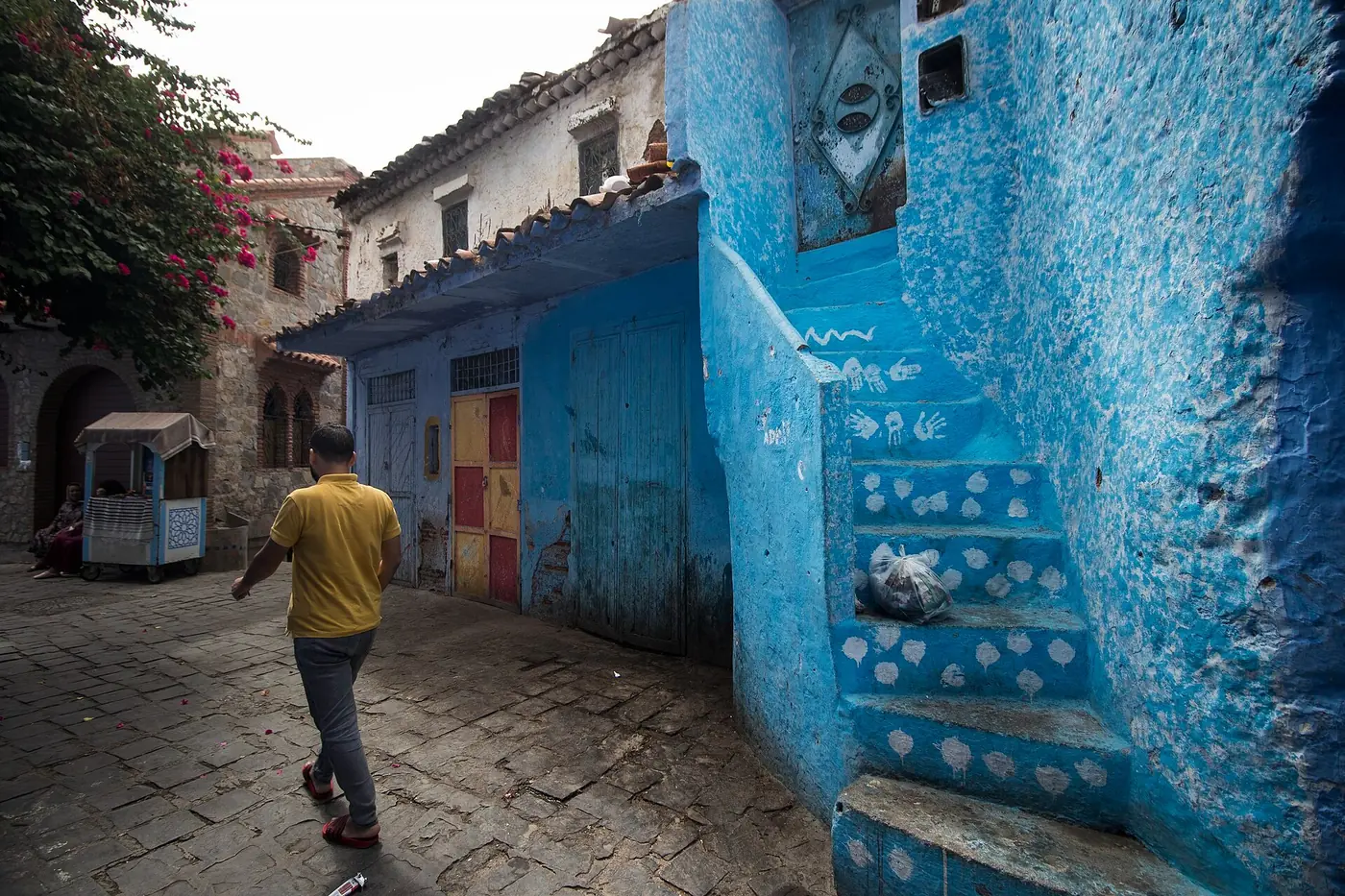
Why is Chefchaouen blue?
Nobody knows for certain. Popular explanations say the blue was brought by Jewish families who settled there, for whom it symbolised the sky, or that it keeps houses cool and mosquitoes away. Today residents repaint their walls regularly and the blue has become the town's signature.
Related: Chefchaouen Travel Guide: Morocco's Blue Pearl in the Rif Mountains
How long should I stay in Chefchaouen?
One night is enough to enjoy the blue medina in the evening and early morning, when it is quiet. Two nights let you add a walk to the Akchour waterfalls in the Rif. Chefchaouen is about four hours by road from Fes and about two from Tangier.
Related: Chefchaouen and northern Morocco
Can non-Muslims visit the Hassan II Mosque?
Yes. The Hassan II Mosque in Casablanca is the only large mosque in Morocco open to non-Muslims, on guided visits outside prayer times. Dress modestly with shoulders and knees covered. Its minaret, about 210 m high, is among the tallest in the world.
Which films were shot at Ait Ben Haddou?
The fortified village of Ait Ben Haddou, a UNESCO World Heritage site since 1987, has appeared in many films and series, including Lawrence of Arabia, Gladiator, The Mummy, Prince of Persia, Alexander and Game of Thrones. Nearby Ouarzazate is known as the 'Hollywood of Africa'.
Related: Aït Ben Haddou: A Complete Guide to Morocco's Most Famous Ksar
What are Morocco's four imperial cities?
Fes, Meknes, Rabat and Marrakech are the four imperial cities: each has served as the capital of the kingdom. Fes has the largest medieval medina, Meknes the monumental gates of Moulay Ismail, Rabat is today's capital, and Marrakech is famous for Jemaa el-Fna and its palaces.
Related: Imperial cities tours
What is Volubilis?
Volubilis is the best-preserved Roman site in Morocco, near Meknes and a UNESCO World Heritage site since 1997. You can walk among its temples, triumphal arch, basilica and fine floor mosaics; it is usually combined with Meknes and the holy town of Moulay Idriss on the way to Fes.
Related: 10-Day Tour from Casablanca: Desert & Imperial Cities
Is it worth spending a night in Essaouira?
Yes, if you have time: evenings and mornings are the most atmospheric moments on the ramparts and at the fishing port, after the day visitors leave. A night or two in Essaouira is a perfect way to rest at the end of a tour before flying home.
Related: Essaouira Travel Guide: Morocco's Windy, Artistic Atlantic Port
What are the Todra and Dades gorges?
They are two spectacular canyons on the road between the Sahara and Marrakech. The Todra Gorge near Tinghir has sheer rock walls several hundred metres high and a short walk along the river; the Dades Valley is known for its red 'monkey fingers' rock formations and winding road.
What is the Road of a Thousand Kasbahs?
It is the route through the valleys south of the High Atlas, from Ouarzazate through Skoura, the Valley of Roses and the Dades Valley towards Tinghir, lined with fortified earthen kasbahs and ksour, palm groves and oases. Most desert tours from Marrakech follow it.
Related: 3-Day Merzouga Tour
Is Tangier worth including in a tour?
Yes, if you have time or are arriving from Spain: Tangier offers the Kasbah and medina above the Strait of Gibraltar and the Hercules Caves, and is close to Asilah's white medina, Tetouan and Chefchaouen. Our longer tours of 20 and 24 days include it.
Related: 20 Days: Exotic Treasures of Morocco
Practical information
Do I need a visa to visit Morocco?
Citizens of many countries, including the European Union, the United Kingdom, the United States, Canada and Australia, can visit Morocco without a visa for up to 90 days. Rules depend on your nationality and can change, so check with the Moroccan embassy or your government's travel advice before booking flights.
How long must my passport be valid?
Your passport should be valid for at least the length of your stay; many travel authorities recommend at least six months of validity beyond your arrival date. Check the current requirement for your nationality before you travel.
What currency is used in Morocco?
Morocco uses the Moroccan dirham (MAD). It is a closed currency, so you can only obtain it once in Morocco: exchange money at the airport, banks or official exchange offices, or withdraw from ATMs. Keep exchange receipts if you want to change dirhams back when you leave.
Related: First time in Marrakech: 12 tips to enjoy the Red City
Can I pay by card or do I need cash?
Cards are accepted in many hotels, riads, larger restaurants and shops in the cities, but cash is essential in souks, small restaurants, taxis, villages and the desert. ATMs are easy to find in towns and rare in the mountains and the Sahara, so carry small dirham notes.
Should I tip in Morocco?
Tipping is customary in Morocco but always at your discretion: in restaurants, for porters and helpers, for local guides, and at the end of a tour for your driver-guide. Keep small dirham notes for tips; performers on Jemaa el-Fna also expect a few dirhams if you photograph them.
What plugs and voltage are used in Morocco?
Morocco uses type C and E plugs (the two round pins common in continental Europe) at 220 V, 50 Hz. Travellers from the UK, the US and other countries need a plug adapter, and US devices that are not dual-voltage also need a converter.
How do I get mobile internet in Morocco?
The easiest way is a local SIM or eSIM from one of the three operators, Maroc Telecom, Orange or inwi, available at the airports and in town with your passport. Coverage is good in cities and along main roads, weaker in remote mountains, and limited in the desert; most riads and hotels offer Wi-Fi.
What time zone is Morocco in?
Morocco uses GMT+1 for most of the year and switches to GMT during the month of Ramadan. Check the time on your phone after landing, especially if your trip falls close to Ramadan.
What languages are spoken in Morocco?
The official languages are Arabic and Amazigh (Tamazight); people speak Moroccan Arabic (Darija) day to day, French is widely used in business and tourism, Spanish is common in the north, and English is increasingly spoken in tourist areas. A few words of Darija, like 'shukran' (thank you), are always appreciated.
Can I travel between cities by train?
Yes, in the north and centre. The national railway connects Tangier, Rabat, Casablanca, Meknes, Fes and Marrakech, and the Al Boraq high-speed train links Tangier and Casablanca in about 2 hours 15 minutes. There are no trains to the desert, the Atlas or Essaouira, which is where a private vehicle helps.
Related: How many days do you need in Morocco? Itineraries from 3 to 24 days
Can I drive myself in Morocco?
Yes. Traffic drives on the right, main roads are generally good, and we can organise a self-drive 4×4 itinerary with accommodation and a desert guide for the off-road sections. Check whether your nationality needs an International Driving Permit, and expect slow, winding mountain roads.
Can I bring a drone to Morocco?
It is best not to. Drones need prior authorisation in Morocco and are often held at customs on arrival. If aerial photography is important to you, ask us in advance and check the current rules with the Moroccan authorities before travelling.
Related: What to pack for a night in the Sahara: a practical checklist
Culture, food and etiquette
What should I wear in Morocco?
Light, comfortable clothes that cover the shoulders and knees are best in the medinas and villages, for both women and men. Swimwear is fine at hotel pools and on the beach. Add a warm layer for the mountains and desert evenings, and comfortable closed shoes for uneven medina lanes.
Related: First time in Marrakech: 12 tips to enjoy the Red City
Can tourists enter mosques in Morocco?
Most mosques in Morocco are closed to non-Muslims. The Hassan II Mosque in Casablanca is the main exception, with guided visits. Several historic religious buildings are open to visitors, such as the Bou Inania and Al-Attarine madrasas in Fes and the Ben Youssef madrasa in Marrakech.
Related: 7 Days: Enchanting Trails of Morocco
Do I have to haggle in the souks?
Bargaining is expected in the souks, and it should stay friendly. Decide what an item is worth to you, start well below the first price and walk away politely if you cannot agree. Fixed-price shops and cooperatives give a useful reference before you buy.
Related: First time in Marrakech: 12 tips to enjoy the Red City
Can I take photos of people?
Always ask first, especially women, children and nomad families, and accept a no gracefully. Street performers and water sellers on Jemaa el-Fna expect a few dirhams for a photo, so agree before you raise your camera. Photographing military or police sites is not allowed.
What Moroccan dishes should I try?
Try a tagine (chicken with preserved lemon and olives, or lamb with prunes), Friday couscous, pastilla from Fes, tangia from Marrakech, harira soup, zaalouk and other salads, msemen pancakes for breakfast, and madfouna, the 'Berber pizza' of the Merzouga area. Finish with mint tea.
Related: Moroccan food: 12 dishes to try and where to eat them
Is Morocco good for vegetarians and vegans?
Yes, with a little planning. Vegetable tagines and couscous, lentil and chickpea dishes, salads such as zaalouk, breads and fresh fruit are easy to find. Tell us your diet when booking and we pass it on to every hotel, camp and restaurant on your route; our cooking class has vegan options.
Can I drink alcohol in Morocco?
Alcohol is available in licensed hotels, many restaurants, bars and some supermarkets, mostly in the cities, but not at street-food stalls or in many traditional medina restaurants. Drinking in public places is frowned upon. Morocco also produces wine, for example at the Val d'Argan vineyard near Essaouira.
Who are the Amazigh (Berber) people?
The Amazigh, often called Berbers, are the indigenous people of North Africa. Their language, Tamazight, is an official language of Morocco, and their villages, kasbahs, carpets, music and hospitality shape much of what you experience in the Atlas Mountains, the southern valleys and the desert.
Related: Atlas Mountains tours
What is the meaning of mint tea in Morocco?
Mint tea is Morocco's national drink and a sign of welcome: green tea brewed with fresh mint and plenty of sugar, poured from high above the glass to make foam. Accepting a glass when it is offered is part of the conversation, in a shop as well as in a family home.
Related: Moroccan food: 12 dishes to try and where to eat them
What are the best souvenirs from Morocco?
Popular souvenirs include Amazigh rugs from Taznakht and the Atlas, argan oil from women's cooperatives, saffron from Taliouine, rose water from the Valley of Roses, leather babouches, ceramics from Safi and Fes, thuya-wood boxes from Essaouira and spices such as ras el hanout.
Safety, health and families
Is Morocco safe for tourists?
Morocco is a popular and generally welcoming destination for tourists. As in any busy country, the main issues are petty theft, persistent sellers and small scams in crowded places, so keep valuables discreet and use licensed guides. Check your government's latest travel advice before you go.
Related: Is Morocco safe for tourists? Honest advice from a local team
Is Morocco safe for women travelling alone or together?
Many women travel in Morocco without problems, though unwanted comments or attention can happen in busy medinas. Dressing modestly, ignoring persistent approaches and travelling with a private driver-guide make things easier, and our team can recommend riads with a calm, safe atmosphere.
Related: Is Morocco safe for tourists? Honest advice from a local team
Can I drink the tap water in Morocco?
Most visitors prefer bottled water, which is cheap and available everywhere and is included on our tours. Avoid ice of unknown origin if you have a sensitive stomach, and wash or peel fruit. A small travel kit with your usual stomach remedies is a good idea.
Do I need travel insurance for Morocco?
Travel insurance is strongly recommended. Choose a policy that covers medical care and repatriation, cancellation and the activities you plan, such as quad biking, hot-air balloon flights, rafting or trekking at altitude, and keep the policy details with you during the trip.
Is Morocco good for a family holiday with young children?
Yes, families are warmly welcomed and children love the camels, the dunes, the waterfalls and the markets. Choose itineraries with shorter drives, stay two nights in the same place when you can, and tell us your children's ages when booking so that suitable car seats and family rooms can be arranged.
Related: Morocco with kids: a family guide to the desert, the Atlas and Marrakech
No question matches your search.