
Sight guide
Kasbah Taourirt: Inside the Glaoui Stronghold of Ouarzazate
Published · 7 min read · By Tarik Belasri, Maroc Service
Visit Kasbah Taourirt in Ouarzazate, the 19th-century earthen stronghold of the powerful Glaoui family: its history, decorated rooms and architecture.
At the eastern edge of Ouarzazate, a fortress of reddish earth rises from the banks of the river, its towers decorated with geometric patterns that catch the low sun. Kasbah Taourirt was once one of the largest and most powerful residences in southern Morocco, the seat of a branch of the Glaoui family, who controlled the caravan routes of the south. Today, it's Ouarzazate's most important monument and a fascinating window into the world of the southern kasbahs.
What Is a Kasbah?
In southern Morocco, a kasbah is a fortified residence, usually built for a powerful family or local leader. It typically has high walls, corner towers and an inner courtyard, with rooms on several floors. Unlike a ksar, which is a fortified village housing many families, a kasbah is usually the domain of a single extended family and its dependants: servants, guards, craftsmen and workers.
Kasbahs were built from rammed earth (pisé) and mud bricks, with roofs of wooden beams, reeds and clay. The upper parts of towers are often decorated with patterns carved into the earth: chevrons, diamonds, arches and niches. This style is typical of the pre-Saharan valleys of the Draa, Dades and Ziz.
The Glaoui Family
The Glaoui were an Amazigh family from the High Atlas, based originally in Telouet, on the caravan route over the Tizi n'Telouet pass. In the late 19th century, they rose to prominence by supporting the sultan and controlling the strategic passes between Marrakech and the south. In return for their loyalty and help, they received weapons, including a famous Krupp cannon, which they used to expand their power over rival tribes.
Under the French Protectorate (1912–1956), Thami El Glaoui, Pasha of Marrakech, became one of the most powerful men in Morocco. He collaborated closely with the French, controlled vast territories in the south and lived in great luxury, hosting celebrities such as Winston Churchill. His opposition to Sultan Mohammed V, whom the French exiled in 1953, made him deeply unpopular among nationalists. After Mohammed V's return in 1955, El Glaoui begged for forgiveness. He died in 1956, and the family's properties were confiscated after independence.
The History of Kasbah Taourirt
Kasbah Taourirt was built mainly in the 19th century, though parts may be older. It belonged to a branch of the Glaoui family and served as an important base for controlling the region of Ouarzazate and the caravan routes linking the Sahara with Marrakech. At its height, in the early 20th century, the kasbah housed hundreds of people, including family members, servants, craftsmen and soldiers, making it a small town in its own right.
After independence, the kasbah was taken over by the state. It fell into disrepair, but parts of it have been restored, notably with support from UNESCO and other partners, and it's now open to visitors. The rest of the kasbah complex remains inhabited by families.
What to See
The Restored Section
The part of the kasbah open to the public was the residence of the Glaoui family members. You'll walk through narrow passages, staircases and courtyards that lead to rooms on several floors. Some rooms are bare, while others have been restored with painted ceilings, carved plaster and zellige.
Decorated Rooms
The highlights are the reception rooms and private apartments, with carved and painted cedar ceilings, stucco decoration in geometric and floral patterns, and tiled floors and walls. These rooms show how the Glaoui used the decorative arts of the Moroccan cities, such as Fes and Marrakech, to display their power in the heart of the south.
The Harem and Private Quarters
Some rooms were reserved for women of the family, with small windows looking onto inner courtyards, ensuring privacy.
The Towers and Terraces
From the upper floors and terraces, you can see the town of Ouarzazate, the river, the palm groves and, on clear days, the High Atlas mountains. The view is especially beautiful at sunset.
The Architecture
Take time to look at the construction: the thick earthen walls, the decorative patterns carved into the towers, the wooden beams, the small windows designed to keep out heat. These features are typical of southern Moroccan architecture and show how builders adapted to the extreme climate.
Kasbah Taourirt on Screen
Like many sites around Ouarzazate, Kasbah Taourirt has appeared in films. Its earthen walls and towers have been used as backdrops for productions set in the Middle East and ancient times. Across the road, the Museum of Cinema, in a former film studio, displays props, costumes and sets from films shot in the region, and makes a good complement to a visit to the kasbah.
A Walk Through Life in the Kasbah
Imagine the kasbah at its peak in the early 20th century. In the lower parts, near the entrance, lived guards, servants and workers, with storerooms for grain, dates, oil and weapons, and stables for horses and mules. Craftsmen worked in small workshops, making tools, leather goods and textiles for the household. The upper floors, reached by narrow staircases, were reserved for the family: reception rooms where the caid received guests and petitioners, private apartments for his wives and children, and terraces where the family could enjoy the evening breeze.
Life was organised around the courtyards, which brought light and air into the heart of the building. Food was cooked over wood fires, bread was baked daily, and water was drawn from wells. The kasbah was a centre of power, where disputes were settled, taxes collected and alliances made.
Practical Tips
- Location: on the main avenue (Avenue Mohammed V) at the eastern end of Ouarzazate.
- Opening hours: generally open daily; check locally.
- Ticket: a small entrance fee.
- Time needed: about 1 hour.
- Guides: local guides can explain the history and point out details. Agree on the price beforehand.
- Accessibility: many stairs and narrow passages; not suitable for wheelchairs.
- Photography: allowed. The decorated rooms and terraces are particularly photogenic.
- Best time: late afternoon, when the light warms the earthen walls.
Nearby Sights
- Museum of Cinema: across the road from the kasbah.
- Atlas Studios: one of the largest film studios in the world, just outside town.
- Tifoultoute Kasbah: another Glaoui kasbah, a few kilometres from Ouarzazate.
- Aït Ben Haddou: the UNESCO-listed ksar, about 30 km away.
- Telouet Kasbah: the original seat of the Glaoui family, in the High Atlas.
The Challenges of Preserving Earthen Heritage
Kasbah Taourirt illustrates the challenges of preserving earthen architecture. Rammed earth is durable if maintained, but rain, wind and lack of maintenance can cause walls to erode and collapse. Many kasbahs in southern Morocco have been abandoned as families moved to modern houses, and they're slowly dissolving into the landscape.
Restoration requires skilled craftsmen who know traditional techniques, as well as funding and long-term commitment. Projects at Taourirt and elsewhere have helped train local workers and raise awareness of this heritage. Visiting these sites and staying in restored kasbah guesthouses helps support their preservation.
Telouet: The Other Glaoui Kasbah
If Kasbah Taourirt sparks your curiosity about the Glaoui, don't miss the Telouet Kasbah, about two hours away in the High Atlas. Telouet was the family's original stronghold, and its reception rooms, decorated by craftsmen from Fes and Marrakech in the early 20th century, are among the most lavish in the south. Much of the building is in ruins, but the remaining rooms, with their painted ceilings, zellige and carved stucco, are stunning. It's an easy detour on the road between Marrakech and Ouarzazate via the Tizi n'Tichka pass.
Private tours that visit Kasbah Taourirt
Want to see Kasbah Taourirt without worrying about transport? These private tours with a local driver-guide include it, and each one can be adjusted to your dates and pace:
- Day Trip to Kasbah Ait Ben Haddou from Marrakech (1 full day)
- 2 Days in the M'hamid El Ghizlane Desert (2 days / 1 night)
- 3 Days from Fes to Marrakech via Merzouga (3 days / 2 nights)
- 3 Days from Marrakech to Fes via the Sahara (3 days / 2 nights)
Prefer your own route? Ask for a tailor-made tour and we will build it around Kasbah Taourirt.
Final Thoughts
Kasbah Taourirt is a gateway to understanding the history and architecture of southern Morocco. Its decorated rooms and earthen towers tell the story of the Glaoui family and the caravan trade, and of the beauty and fragility of earthen buildings. If you're passing through Ouarzazate on your way to the desert, take an hour to explore it.
Frequently Asked Questions
Who built Kasbah Taourirt?
It was built and expanded by a branch of the Glaoui family, mainly in the 19th century.
How long does it take to visit Kasbah Taourirt?
About 1 hour.
Is Kasbah Taourirt worth visiting?
Yes, especially for its decorated rooms and insight into Glaoui history.
Are people still living in Kasbah Taourirt?
Yes, parts of the kasbah complex are still inhabited by local families.
What's near Kasbah Taourirt?
The Museum of Cinema, Atlas Studios, Tifoultoute Kasbah and Aït Ben Haddou.
Can I visit Kasbah Taourirt without a guide?
Yes, though a guide adds useful historical context.
Sources
More travel guides
 City guide
Ouarzazate Travel Guide: The Gateway to the Sahara and Morocco's Hollywood
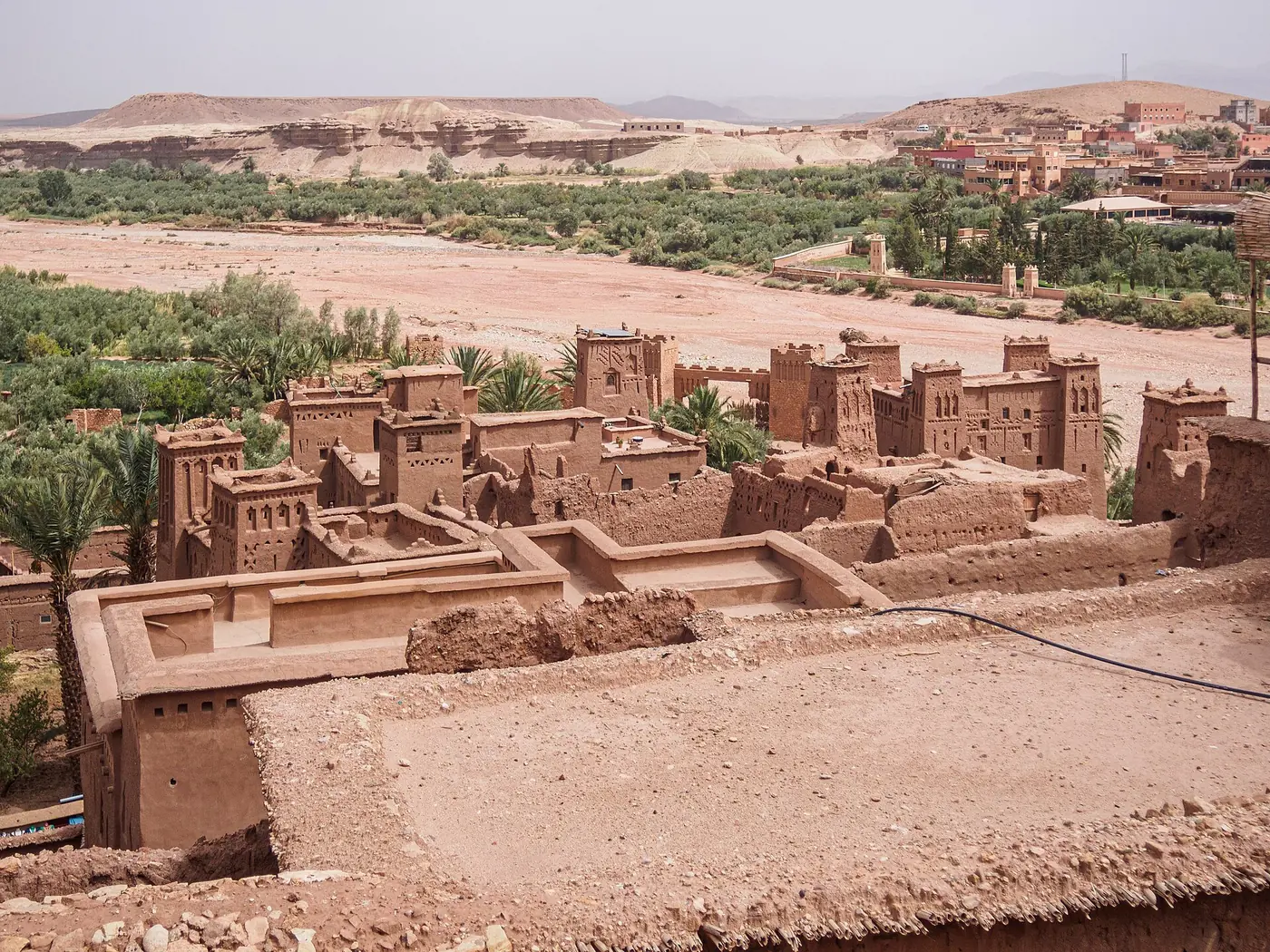
Discover Ouarzazate, Morocco's "door of the desert": Kasbah Taourirt, Atlas Studios, Aït Ben Haddou, the Noor solar plant and the Valley of Roses.
 Village guide
Aït Ben Haddou: A Complete Guide to Morocco's Most Famous Ksar
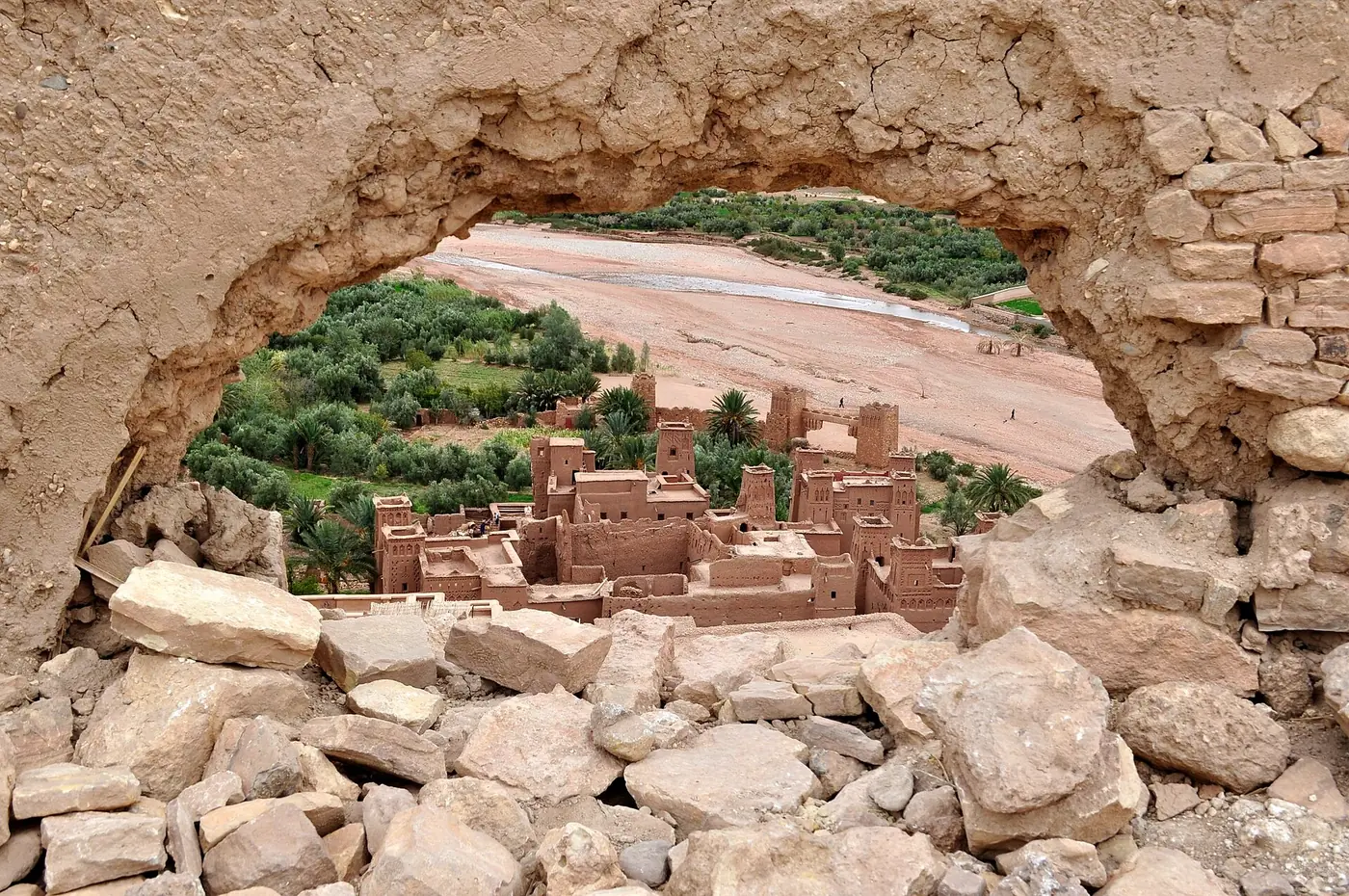
Everything you need to know before visiting Aït Ben Haddou, the UNESCO-listed earthen ksar near Ouarzazate: its history, what to see and films shot there.
 Sight guide
Hassan II Mosque: A Visitor's Guide to Casablanca's Masterpiece on the Sea
Plan your visit to the Hassan II Mosque in Casablanca, one of the largest mosques in the world and one of the few in Morocco open to non-Muslims.