Sight guide
The Chouara Tannery of Fes: How to Visit Morocco's Most Famous Leather Works
Published · 7 min read · By Tarik Belasri, Maroc Service
A complete guide to the Chouara Tannery in Fes: its history, how traditional leather tanning works and the best viewing terraces.
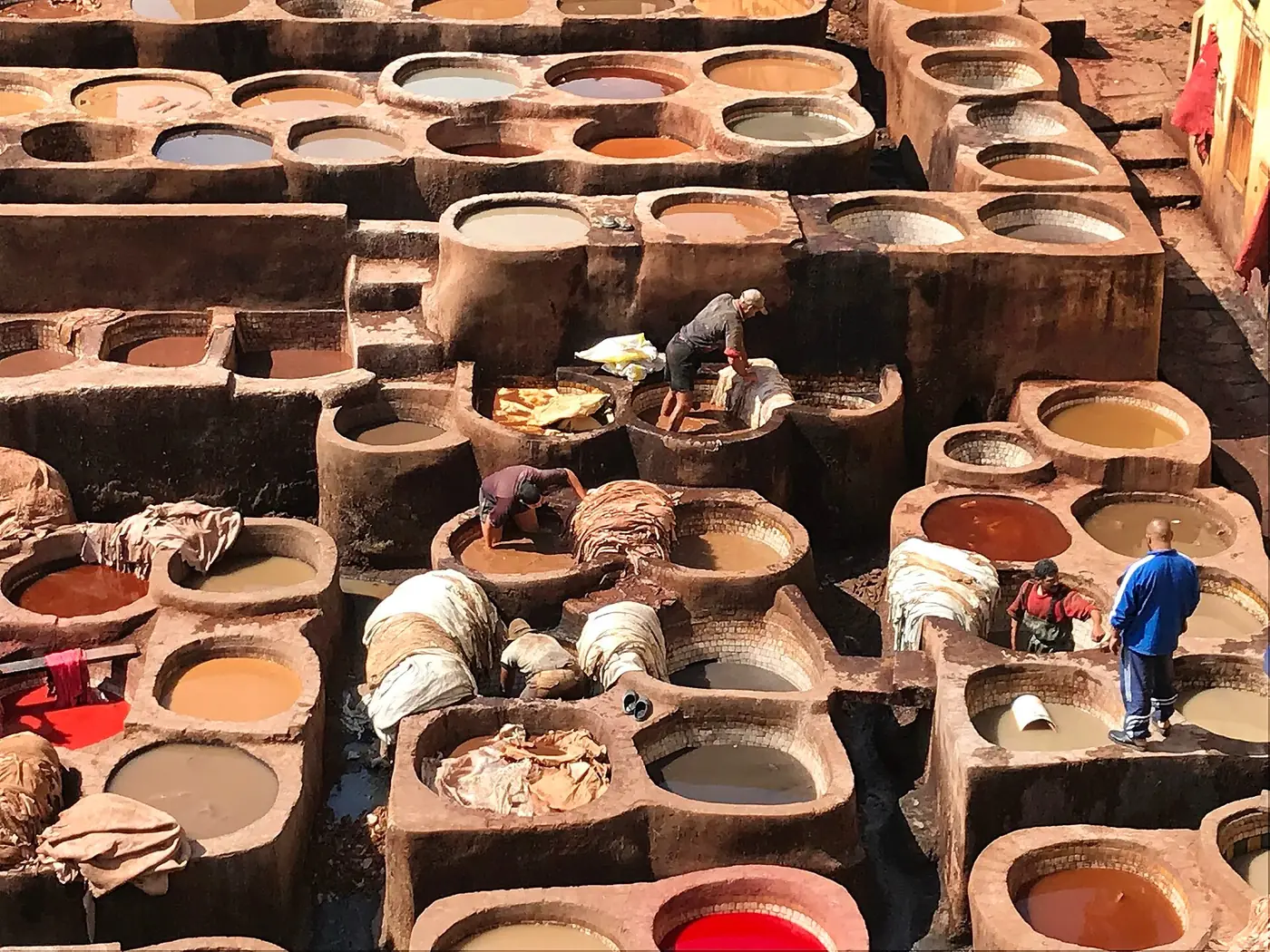
From a terrace above the rooftops of Fes, you look down on a scene that seems unchanged for centuries: a honeycomb of stone pits filled with liquids in shades of white, red, yellow, brown and blue. Men stand knee-deep in the vats, working animal hides with their hands and feet. Skins dry on the surrounding roofs, and the air carries a strong, unforgettable smell. This is the Chouara Tannery, the largest and most famous of the tanneries of Fes, and one of the most iconic sights in Morocco.
History
Leather tanning in Fes dates back many centuries, and the Chouara Tannery is often said to have been operating since around the 11th century, though exact dates are difficult to confirm. Fes has long been one of the great leather-producing cities of the Islamic world, exporting fine leather across North Africa, the Middle East and Europe. The tannery is located in the old medina, Fes el-Bali, near the Oued Fes river, which provided the water essential to the tanning process.
The tannery was restored in 2015 and 2016 as part of a broader rehabilitation programme for the Fes medina, with improvements to working conditions, the structure and the viewing terraces, while preserving its traditional appearance.
How Traditional Tanning Works
The tanning process at Chouara is largely done by hand, using techniques that have changed little over the centuries.
Step 1: Cleaning and Softening
Raw hides of cows, sheep, goats and camels are first soaked in vats containing a mixture of water, quicklime and salt. This helps remove hair, fat and flesh and softens the hides. These are the white vats you see from the terraces.
Step 2: Pigeon Droppings Bath
The hides are then soaked in a solution containing pigeon droppings, which contain ammonia and enzymes that soften the leather further and make it more supple, preparing it to absorb dyes. This step is responsible for much of the strong smell.
Step 3: Tanning
Next, the hides are tanned using natural ingredients, traditionally including tree bark and other plant materials, which transform the hides into durable leather.
Step 4: Dyeing
The leather is then dyed in the coloured vats. Traditionally, natural dyes were used, such as poppy for red, indigo for blue, henna for orange, saffron for yellow, mint for green and cedar wood for brown. Today, both natural and synthetic dyes are used.
Step 5: Drying and Finishing
The dyed hides are hung to dry in the sun on the rooftops and terraces, then softened, scraped and finished by craftsmen before being turned into products.
The Workers
Tanning is hard physical work, done in difficult conditions. Many tanners belong to families that have practised the trade for generations, and the work is often passed down from father to son. They spend hours in the vats, in the heat and smell, working the hides with their hands and feet. Visitors should be respectful, avoid treating workers as a spectacle, and ask permission before photographing individuals up close.
How to Visit
Access Through the Leather Shops
The tannery itself is a working site, not a museum. You view it from the terraces of the leather shops that surround it. You'll enter a shop, climb several flights of stairs past displays of leather goods, and reach a terrace overlooking the vats.
There's no official entrance fee. The shops provide access in the hope that you'll buy something. If you don't, it's customary to give a small tip.
The Mint
At the entrance, someone will usually hand you a sprig of fresh mint to hold under your nose to help with the smell. The smell can be strong, especially in hot weather, but most people get used to it after a few minutes.
Finding the Tannery
The tannery is in the lower medina, near the Seffarine Square and the Quaraouiyine. Follow signs or ask locals, but beware of people who insist on guiding you; they often expect a commission or tip. If you're unsure, ask your riad for directions or hire a licensed guide.
Best Time to Visit
- Morning: the best time, when the vats are full of colourful dyes and the workers are busy. The light is also good for photos.
- Afternoon: activity may be lower, and some vats may be empty.
- Friday: activity is often reduced, especially around midday prayers.
- Summer: the smell is stronger in hot weather.
- Rain: after rain, the vats may be less colourful, and work may slow down.
Buying Leather
The shops around the tannery sell a huge range of leather goods: bags, jackets, wallets, belts, poufs and babouches (slippers). Quality and prices vary.
Tips for Buying
- Check quality: look at stitching, lining, zips and the feel of the leather. Good leather is soft, supple and evenly coloured.
- Smell it: fresh leather may still have a slight smell, which fades over time.
- Compare prices: look at several shops before buying.
- Bargain: start lower than the asking price and negotiate. Be friendly and patient.
- Don't feel pressured: shopkeepers can be persuasive, but you're under no obligation to buy.
- Custom orders: some shops can make jackets or bags to measure in a few days.
Popular Items
- Babouches: traditional slippers, often in bright colours.
- Poufs: leather ottomans, sold flat and stuffed at home.
- Bags: from small clutches to large travel bags.
- Jackets: made to measure in some shops.
Other Tanneries in Fes
Besides Chouara, Fes has other tanneries, including:
- Sidi Moussa Tannery: smaller, near the Quaraouiyine, often less crowded.
- Ain Azliten Tannery: in the northern part of the medina, near Bab Guissa.
These tanneries offer a more intimate view of the tanning process and are less busy with tourists.
Photography Tips
The tannery is one of the most photographed places in Morocco. For the best shots, go in the morning when the vats are full of colour and sunlight falls on the pits. Climb to the highest terrace available for a wide view, and use a zoom lens to capture details of the workers and dyes without intruding. Include the surrounding rooftops and the medina in the background to give context. Remember that the workers are doing hard physical labour: ask permission for close-up portraits, and respect their wishes if they decline.
A Brief Guide to Moroccan Leather Types
Fes produces leather from several animals, each with different qualities. Goat leather is soft, light and durable, often used for bags, babouches and book covers. Sheep leather is very soft and supple, ideal for jackets and gloves. Cow leather is thicker and sturdier, used for belts, poufs and larger bags. Camel leather is tough and rugged, used for more durable goods. Ask shopkeepers about the type of leather in the item you're considering.
Avoiding Scams
- Fake guides: people may offer to lead you to the tannery, then demand a fee or take you to a shop where they earn a commission. Politely decline, or agree on a price beforehand.
- "Closed" tannery: someone may claim the tannery is closed and offer to take you elsewhere. It's rarely true.
- Pressure to buy: you're not obliged to buy anything. A small tip is enough if you only want to view the tannery.
Environmental and Social Issues
Traditional tanning involves chemicals and waste that can pollute water and affect workers' health. The 2015–2016 restoration aimed to improve working conditions and reduce environmental impacts, but challenges remain. Supporting shops that treat workers fairly and buying quality products contributes to the sustainability of this traditional craft.
Private tours that visit the Chouara Tannery
Want to see the Chouara Tannery without worrying about transport? These private tours with a local driver-guide include it, and each one can be adjusted to your dates and pace:
- 2 Days from Fes to Merzouga and the Sahara (2 days / 1 night)
- 3 Days from Fes to Marrakech via Merzouga (3 days / 2 nights)
- 3 Days from Marrakech to Fes via the Sahara (3 days / 2 nights)
- 4 Days from Fes to Marrakech via Erg Chebbi (4 days / 3 nights)
Prefer your own route? Ask for a tailor-made tour and we will build it around the Chouara Tannery.
Final Thoughts
The Chouara Tannery is one of the most memorable sights in Fes, offering a glimpse into a centuries-old craft that remains part of the city's identity. Visit in the morning, hold your mint, take in the colours and the scene below, and remember the people behind the work. Buy a bag or don't; the view from that terrace is the part people remember.
Frequently Asked Questions
Is there an entrance fee for the Chouara Tannery?
No, but you view it from shop terraces, and a small tip is expected if you don't buy.
Why do they give you mint at the tannery?
To help mask the strong smell of the tanning process.
What is the best time to visit the Chouara Tannery?
In the morning, when the vats are full of colour and workers are active.
Is leather from Fes good quality?
It can be excellent, but quality varies. Check carefully before buying.
Are there other tanneries in Fes?
Yes, including the Sidi Moussa and Ain Azliten tanneries.
Sources
- UNESCO World Heritage Centre, Medina of Fes
- Encyclopaedia Britannica, Idrīs II (founder of Fes)
- Encyclopaedia Britannica, Tanning
- Moroccan National Tourist Office, Visit Morocco
Part 2
Español
30 blogs
Español
Ciudades
15 blogs
Explore our trips
More travel guides
 Sight guide
Bou Inania Madrasa: A Masterpiece of Marinid Art in Fes and Meknes
Visit the Bou Inania Madrasa in Fes, one of the finest examples of Marinid architecture and one of the few religious buildings in Morocco open to non-Muslims.
 City guide
Fes Travel Guide: How to Explore the World's Largest Car-Free Medina
Plan your trip to Fes, Morocco with this detailed guide to Fes el-Bali, the Chouara tannery, Al Quaraouiyine, Bou Inania Madrasa, riads, food and guides.
 Sight guide
Volubilis: Visiting Morocco's Finest Roman Ruins
A practical guide to Volubilis, the UNESCO-listed Roman city near Meknes: its history, the best mosaics and the Triumphal Arch of Caracalla.