Village guide
Akchour Travel Guide: Waterfalls, Turquoise Pools and God's Bridge in the Rif
Published · 12 min read · By Tarik Belasri, Maroc Service
Plan your visit to Akchour, near Chefchaouen: how to get there, the hike to the Akchour waterfalls and the trail to God's Bridge (Pont de Dieu).
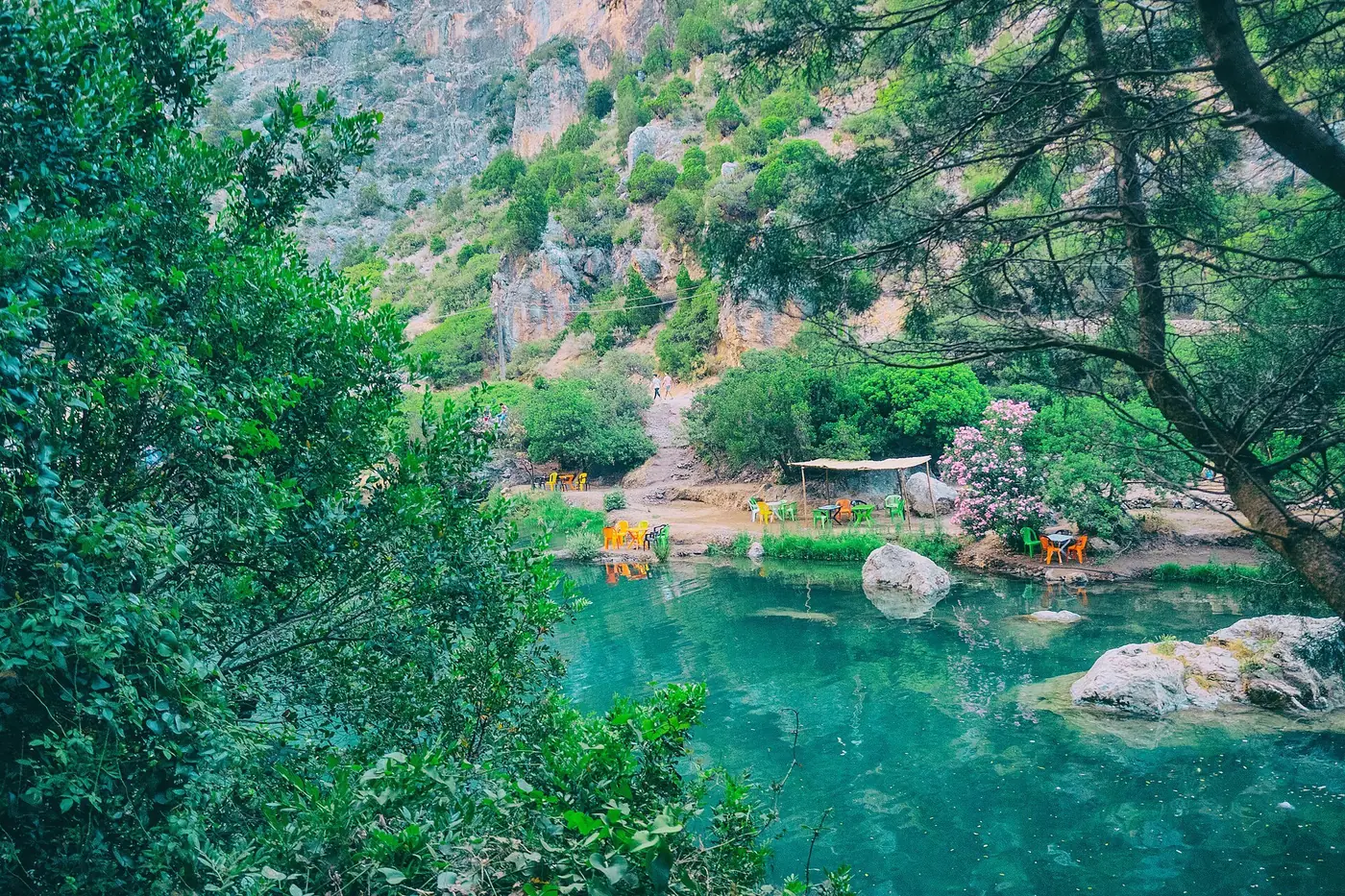
Most people come to northern Morocco for the blue lanes of Chefchaouen. But less than an hour away, hidden in the folds of the Rif Mountains, is one of the most beautiful natural sites in the country. At Akchour, the Oued Farda river has carved deep limestone gorges, filling them with emerald and turquoise pools, small cascades and a larger waterfall that crashes into a green pool. A second trail leads to a natural rock arch spanning the gorge, high above the river, known as God's Bridge.
Akchour is the perfect day trip from Chefchaouen for hikers, swimmers, photographers and anyone who needs a break from cities. This guide explains how to get there, which trails to take and how to make the most of your visit.
Where Is Akchour?
Akchour is a small village in the Rif Mountains, in the province of Chefchaouen, about 30 km northeast of Chefchaouen town as the crow flies, roughly 45 minutes to an hour by road. It lies at the edge of the Talassemtane National Park, near the confluence of the Oued Farda and Oued Kelaa rivers. A dam and reservoir at the entrance of the valley mark the start of the trails.
Talassemtane National Park
Akchour sits at the southern edge of Talassemtane National Park, created in 2004 to protect one of the most important forest ecosystems in Morocco. The park covers limestone mountains, deep gorges and forests of cedar, pine, holm oak and the rare Moroccan fir (Abies marocana), a species found only in this part of the Rif.
The park is also home to wildlife, including the endangered Barbary macaque, wild boar, foxes, genets, eagles, vultures and a rich variety of butterflies and plants. For hikers, it offers some of the best trekking in northern Morocco, with trails linking villages, peaks and valleys.
The Two Main Trails
From the parking area at the end of the road, near the dam, two trails start along the river. Most visitors choose one, but fit hikers can do both in a long day.
Trail 1: The Akchour Waterfalls (Grande Cascade)
This trail follows the Oued Farda upstream to the big waterfall. It's the most popular route and the one most people mean when they talk about Akchour.
The path starts by crossing a bridge and climbing along the river, past small cafés serving tea, orange juice and tagines. You'll see a series of pools and smaller cascades on the way. The first significant waterfall, sometimes called the "small waterfall," is about 30 to 45 minutes from the start. Many day-trippers stop here to swim.
Continuing upstream, the trail becomes rockier and climbs higher above the river, crossing streams and passing through shaded forest. After about 2 to 2.5 hours from the start (depending on your pace), you reach the Grande Cascade, a waterfall of about 20 metres or so plunging into a deep pool, surrounded by cliffs covered in moss and ferns. It's a spectacular spot to rest, have a picnic and, if you're brave, swim in the cold water.
The return takes about the same time on the same trail.
Difficulty: moderate. The path is uneven, rocky in places, with some steep sections and stream crossings. Good walking shoes are essential.
Trail 2: God's Bridge (Pont de Dieu)
The second trail leads to God's Bridge, a natural limestone arch that spans the gorge of the Oued Farda, about 25 metres above the river. It's one of the most impressive natural formations in Morocco.
From the start, the trail climbs to the right of the river, through forest and rocky slopes, with views over the gorge. After about 1 hour to 1.5 hours, you reach a viewpoint above the arch, and you can walk across the top of God's Bridge itself. Paths also lead down to the river below the arch, where you can look up at it from beneath and swim in the pools.
Difficulty: moderate, with steeper sections than the waterfall trail. Be careful near the edges, especially on the arch.
Combining Both Trails
Strong hikers can combine both trails in one day, starting early. Some local guides know a connecting path through the hills that links God's Bridge and the river valley. Allow 6 to 8 hours in total.
Swimming at Akchour
The pools of Akchour are beautiful for swimming in summer, with clear green and turquoise water. The water is cold, fed by springs and mountain streams, even in the heat of July and August. Popular swimming spots include the pools near the small waterfall, the area below God's Bridge, and the pool at the Grande Cascade.
Be careful: rocks can be slippery, some pools are deep, and currents can be strong after rain. Don't jump into water unless you know its depth. Children should be supervised at all times.
The Landscape: How the Gorges Were Formed
The mountains around Akchour are made largely of limestone, a rock formed from the shells and skeletons of marine creatures that accumulated at the bottom of ancient seas. When the African and European plates pushed against each other, these layers were lifted, folded and fractured, creating the Rif Mountains.
Limestone dissolves slowly in slightly acidic rainwater. Over hundreds of thousands of years, water seeping through cracks widened them into caves and underground channels, while rivers cut down into the rock, carving the narrow gorges you see today. God's Bridge is believed to be the remains of a cave or tunnel roof that collapsed, leaving only the arch spanning the river. The turquoise colour of the pools comes from dissolved minerals and fine particles that reflect light, combined with the depth and clarity of the water.
Springs are common in this kind of landscape, which is why the rivers of Akchour keep flowing even in summer, when much of Morocco is dry. These springs also feed villages and fields downstream, making the forests and limestone of Talassemtane a vital water reserve for the region.
Wildlife and Plants to Look For
Keep your eyes open as you walk. Along the river, you may spot kingfishers, dippers and grey wagtails. In the forest, listen for woodpeckers and look up for birds of prey circling above the cliffs, including booted eagles, short-toed eagles and, with luck, a Bonelli's eagle. Butterflies are abundant in spring and early summer.
The vegetation changes with altitude: oleander and willow by the river, then holm oak, cork oak and pine on the slopes, and higher up, cedar and the rare Moroccan fir. In spring, wild orchids, cyclamen and other flowers bloom along the trails. Barbary macaques live in the higher forests of the park, though they're less often seen near the busy trails of Akchour.
Longer Treks in Talassemtane
Akchour is also a gateway to multi-day trekking in Talassemtane National Park. Classic routes link Chefchaouen and Akchour over the mountains, passing through forests of fir and cedar, remote villages and high plateaus. Other treks climb toward Jbel Lakraa, one of the highest peaks in the western Rif, or cross the park toward the Mediterranean coast near Oued Laou.
These treks require a local guide, as trails are not always marked and weather can change quickly. Guesthouses and gîtes in mountain villages offer basic accommodation and meals. Spring and autumn are the best seasons.
When to Visit Akchour
- Spring (March to May): the best time for hiking, with full rivers, powerful waterfalls, green vegetation and wildflowers. Water may be too cold for swimming, and some stream crossings may be harder.
- Summer (June to August): ideal for swimming, but very busy, especially on weekends and holidays when Moroccan families flock to the site. Go early in the morning.
- Autumn (September to November): quieter, pleasant temperatures and beautiful colours. Water levels lower.
- Winter (December to February): cold and often rainy. After heavy rains, trails can be dangerous or closed due to high water and slippery rocks. Check local conditions with your guesthouse before going.
How to Get to Akchour
From Chefchaouen
- Grand taxi: the most common option. Shared or private grand taxis leave from Chefchaouen for Akchour. Agree on the price beforehand and arrange a pick-up time for the return, or find a taxi at the parking area.
- Organised tour: many guesthouses and agencies in Chefchaouen organise day trips with transport, sometimes with a guide.
- Car: the road from Chefchaouen goes toward Tetouan, then turns off toward Akchour. There's parking near the start of the trails (small fee).
- Hiking from Chefchaouen: experienced hikers can trek from Chefchaouen to Akchour over the mountains through Talassemtane National Park in one or two days, with a guide.
From Tetouan or Tangier
Akchour can also be reached from Tetouan (about 1.5 hours) or Tangier (about 2.5 hours), but staying in Chefchaouen is more convenient.
Where to Eat
Along the trails, especially near the start and around the first waterfalls, small cafés and restaurants serve tagines, omelettes, grilled meat, salads, fresh orange juice and mint tea. Some have tables set right by the water, where you can dip your feet while you eat. Prices are reasonable but a bit higher than in town. Bring snacks and water for the upper parts of the trails, where there are fewer services.
Where to Stay
Most visitors stay in Chefchaouen and visit Akchour as a day trip. However, there are a few guesthouses and eco-lodges in the Akchour area and nearby villages, offering a quieter experience close to nature. Staying nearby allows you to start the hikes early before day-trippers arrive.
What to Pack
- Sturdy walking shoes or trail sandals with good grip
- Swimsuit and quick-dry towel
- Water (at least 1.5 litres per person) and snacks
- Sun protection: hat, sunscreen, sunglasses
- Light rain jacket in spring and autumn
- Small first-aid kit
- Waterproof bag for your phone
- Cash for taxis, cafés and parking
- Change of clothes
Safety Tips
- Weather: avoid hiking during or after heavy rain. Rivers rise quickly, and trails become slippery.
- Water crossings: be careful crossing streams; use a stick for balance.
- Edges: stay away from cliff edges, especially on God's Bridge.
- Heat: start early in summer, and carry enough water.
- Guides: a local guide is useful for longer or less obvious routes.
- Phone signal: coverage is limited in the gorges.
Respecting Nature and Local Communities
Akchour's popularity has brought challenges, including litter, pollution of the water and pressure on local resources. Help keep it beautiful:
- Carry out all your rubbish.
- Don't use soap or shampoo in the river.
- Stay on marked paths.
- Respect wildlife, and don't feed animals.
- Dress modestly when walking through villages.
- Support local cafés, guides and taxi drivers.
A Note on the Rif and Its People
The Akchour area is part of the Jbala region of the western Rif. Villagers traditionally live from small-scale farming, livestock, olive trees and, historically, cannabis cultivation, which is widespread in parts of the Rif. You may be offered hashish. It's illegal for recreational use in Morocco, and buying or using it can result in arrest. Politely decline.
The people of the region are known for their hospitality. Jbala women often wear the distinctive striped red-and-white mendil cloth and wide straw hats with woollen pompoms.
Akchour for Families
Akchour can be a wonderful day out with children, as long as you choose the right trail. The first section of the waterfall trail, up to the small waterfall and the first pools, is manageable for most children over about six, and the cafés along the way make for easy breaks. The full hike to the Grande Cascade and the trail to God's Bridge are more demanding, with steep, rocky sections and drops near the edges, so they're better for older children and teenagers who are used to hiking. Bring water shoes, plenty of snacks and a change of clothes, and keep a close eye on children near the water.
Photography Tips
Akchour is extremely photogenic. The best light in the gorges is in the middle of the day, when sunlight reaches the bottom of the canyon and lights up the turquoise pools. Early morning and late afternoon give softer light on the forested slopes. A polarising filter helps cut reflections on the water and deepens the colours. For waterfalls, a small tripod and a slower shutter speed will give the water a silky look. Protect your camera from splashes, and be careful on slippery rocks while framing your shots.
Suggested Day Trip Itinerary
8:00 a.m.: Leave Chefchaouen by grand taxi.
9:00 a.m.: Arrive at Akchour and start the hike to the Grande Cascade.
11:30 a.m.: Reach the waterfall. Rest, swim and have a picnic.
1:30 p.m.: Start walking back, stopping at the pools on the way.
3:30 p.m.: Lunch or tea at a riverside café.
5:00 p.m.: Return to Chefchaouen.
Alternatively, start with God's Bridge in the morning and spend the afternoon swimming near the first waterfall.
Private tours that visit Akchour
Want to see Akchour without worrying about transport? These private tours with a local driver-guide include it, and each one can be adjusted to your dates and pace:
- 5-Day Holiday: Marrakech to Chefchaouen via Ifrane (5 days)
- 8 Days: Marrakech to Marrakech (8 days / 7 nights)
- 9 Days: Discover the Wonders of Morocco (9 days / 8 nights)
- 9 Days: Immerse in the Beauty of Morocco (9 days / 8 nights)
Prefer your own route? Ask for a tailor-made tour and we will build it around Akchour.
Final Thoughts
Akchour is a reminder that Morocco isn't only deserts and medinas. Here, in the green heart of the Rif, rivers carve canyons, waterfalls tumble into turquoise pools and a natural bridge spans a gorge. Whether you come to hike, swim or simply escape the heat, Akchour is one of the most refreshing experiences in northern Morocco.
Pack a swimsuit, start early, take your time on the trails and leave nothing behind but footprints. The river, the forest and the people of the Rif will do the rest.
Frequently Asked Questions
How far is Akchour from Chefchaouen?
About 45 minutes to 1 hour by car or grand taxi.
How long is the Akchour waterfall hike?
About 2 to 2.5 hours each way to the Grande Cascade.
How long is the hike to God's Bridge?
About 1 to 1.5 hours each way.
Can you swim at Akchour?
Yes, in summer. The water is cold and clear.
Do I need a guide for Akchour?
Not for the main trails, which are easy to follow, but a guide is useful for longer routes and combining trails.
Is Akchour crowded?
On summer weekends and holidays, yes. Visit on a weekday and start early for a quieter experience.
Is there an entrance fee for Akchour?
There's no park entrance fee for the main trails, but expect to pay a small parking charge if you come by car.
Can I visit Akchour in winter?
Yes, but trails can be slippery or flooded after rain. Check local conditions with your guesthouse before going.
Sources
More travel guides
 Sight guide
God's Bridge (Pont de Dieu): Hiking to Akchour's Natural Rock Arch
A guide to God's Bridge (Pont de Dieu) near Akchour and Chefchaouen: how this natural limestone arch formed and the hiking trail.
 City guide
Chefchaouen Travel Guide: Morocco's Blue Pearl in the Rif Mountains
Everything you need to plan a trip to Chefchaouen, Morocco's famous blue city: why it's blue, the best photo spots, the Kasbah and the Spanish Mosque.
 Village guide
Ourika Valley Travel Guide: The Easiest Escape from Marrakech into the Atlas
Everything you need to plan a trip to the Ourika Valley from Marrakech: Setti Fatma and its seven waterfalls, Amazigh villages and argan cooperatives.